I've Been Automating Since I Was 12 (And Got Banned For It)
Most people discover automation at work. I discovered it in a dungeon full of scorpions. From RuneScape mining bots to building custom business automation, here's how it all started.

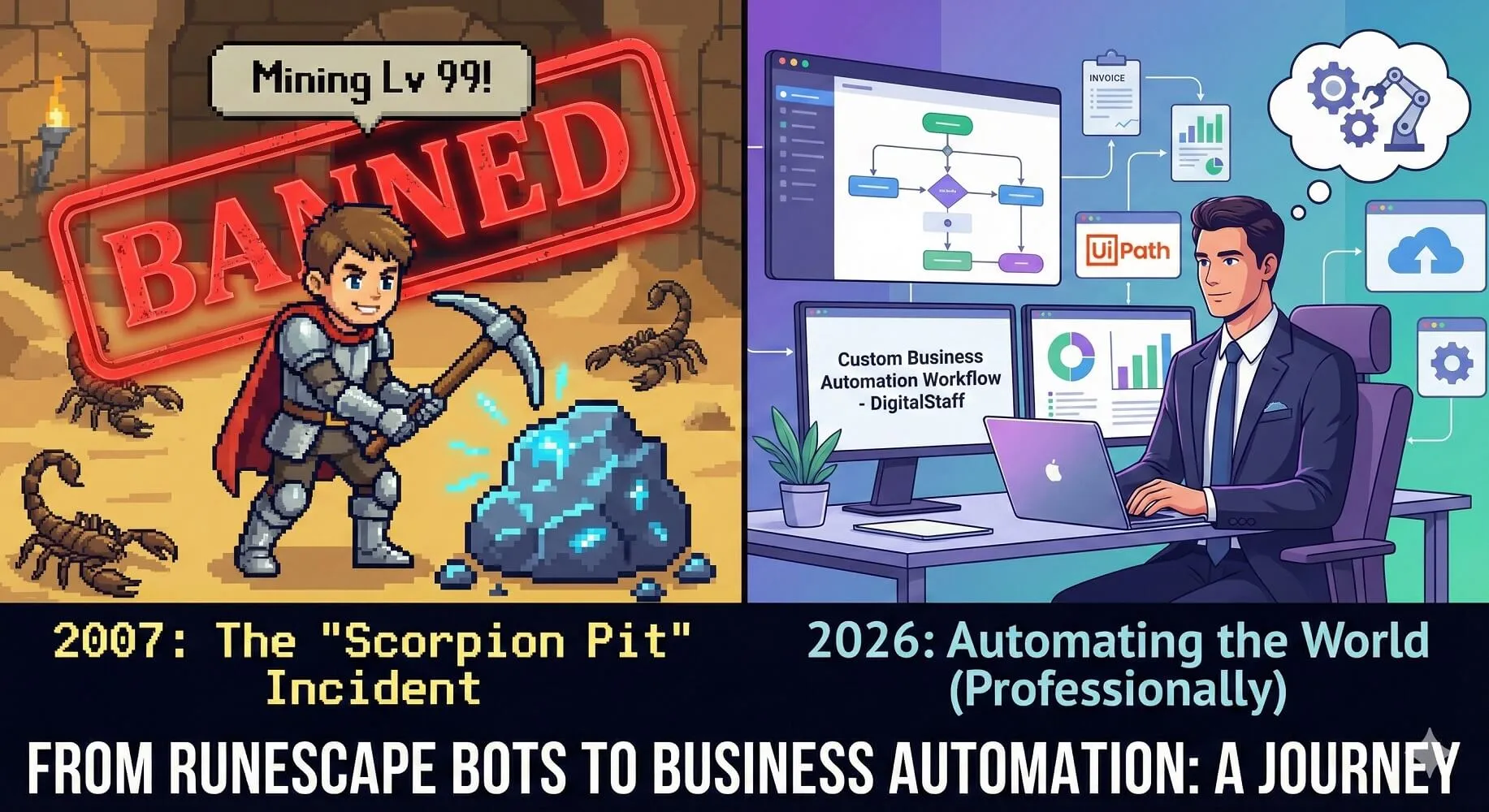
Most people discover automation at work, someone shows them an Excel macro or they stumble across Zapier. I discovered it in a dungeon full of scorpions.
Today I run DigitalStaff, where we automate repetitive work for real businesses. But the first time I felt the power of automation I was a kid trying to avoid clicking virtual rocks for three hours a night in RuneScape.
The Year Is 2006. I’m Mining Virtual Rocks on the Family Computer
When I was 12, I was obsessed with a game called RuneScape. If you’ve never played it, imagine a medieval fantasy world where you can fight goblins, brew potions, complete quests, and, critically, mine rocks for iron ore that you sell for gold pieces.
The problem? Mining is boring. You walk to the rocks. You click. You wait. You click again. Your inventory fills up after about five minutes, so you walk back to the bank, deposit everything, and do it all over again. Forever.
I wanted the gold, but I did not want to click rocks for three hours after school every day. I was 12. I had things to do. Probably not important things, but things nonetheless.
So I went looking for a shortcut.
My First “Employee” Was a Bot I Downloaded Off the Internet
I found out that people were building programs, bots, that could play the game for you. You’d download the software (and probably a few viruses along the way), point it at your account, and let it rip.
So that’s exactly what I did. I found a mining bot, installed it on the family computer in the living room, and set it up at about 10 PM one night. I logged into my account, positioned my character at the mines, started the bot, and went to bed.
When I woke up the next morning, I had thousands of ore sitting in my bank. I sold it all and suddenly had millions of gold pieces. I felt like a criminal mastermind. I was 12 and I had just automated my first process.
Here’s the thing though, I didn’t write that bot. Someone much smarter than me coded the whole thing, packaged it up, and sold it online for like $20. I was just the guy pressing “Start.” I was a bot operator, not a bot builder.
At the time, writing your own RuneScape bot required serious programming knowledge. You had to understand how the game client worked, how to read pixels on the screen, how to simulate mouse clicks, real nerd stuff. So most players just bought pre-made bots and ran them.
Sound familiar? That’s basically what most businesses do today with automation. You sign up for Zapier, or you use the built-in automations in your CRM, or you buy a tool like IFTTT. You’re running automations that someone else designed. They work fine for simple stuff, but the moment you need something custom? You’re stuck.
It Also Kind of Ruined the Game
Here’s the part nobody tells you about automating a video game: it takes the fun out of it.
The whole point of RuneScape was the journey, the grind, the slow progress, the satisfaction of leveling up after hours of work. When I automated all of that, I skipped the journey entirely. I had all the gold but none of the experience.
I’m not going to pretend there’s a deep business lesson here. This part is just me admitting that 12-year-old me learned a valuable life lesson about shortcuts. But I will say this: in business, automating the boring stuff doesn’t ruin anything. Nobody has ever said, “Man, I really miss manually entering 200 invoices into QuickBooks.”
Fast Forward: I Built My Own Bot (And Got Banned)
A couple of years ago, I decided to revisit the RuneScape bot idea, except this time, I’d build it myself. I’d spent years learning automation tools professionally, so I figured: why not put those skills to the test in the most ridiculous way possible?
Using UiPath (a professional-grade automation platform that normally automates things like invoice processing and data entry), I built a bot that could fight scorpions in a dungeon, eat fish to heal, walk to a river to catch more fish, cook the fish, and then go back to fighting scorpions. On a loop. Indefinitely.
I was extremely proud of myself.
I let it run for a few hours while I went and did other things. When I came back to check on my little scorpion-fighting masterpiece, I found something unexpected.
I got banned.
Turns out, a game moderator had wandered into the dungeon, saw my character fighting scorpions with robotic efficiency, and tried to talk to me. My bot, being a bot, said nothing. It just kept fighting scorpions. Then, thanks to a small bug, my character got stuck in a corner, not fighting, not responding, not logging out. Just… standing there. Like a mannequin in medieval armor.
That’s a dead giveaway. Real players log out when they’re idle. Bots don’t. Ban hammer: activated.
I haven’t built a RuneScape bot since. But the skills I used? Those went somewhere much more productive.
Same Skills, Real Businesses
The thing is, what I do now at DigitalStaff isn’t that different from what I was doing at 12, just with higher stakes and fewer scorpions.
Back then, the process was: walk to the rocks, click, collect ore, walk to the bank, deposit, repeat. Today, a typical client’s process looks like: open an email, download an invoice, enter the data into QuickBooks, file it, move on to the next one, repeat. Same structure. Same repetition. Same waste of human time.
The difference is how I approach it now.
When I was 12, I was downloading someone else’s bot and hoping it worked. When most businesses start with automation today, they’re doing the same thing, signing up for off-the-shelf tools and hoping the pre-built templates fit their workflow. Sometimes they do. Often, they don’t.
What’s changed for me is that I’ve gone from being the kid who runs the bots to the person who builds them. From scratch. Tailored to whatever the business actually needs. It doesn’t matter what software you’re using, what your process looks like, or how weird your edge cases are. If a human is doing it repetitively on a computer, it can be automated, and I can build the thing that does it.
From Off-the-Shelf to Custom-Built
Here’s how I think about the evolution:
Phase 1: Running other people’s automations. This is where most businesses start. You use Zapier, Power Automate, or whatever tool comes built into your software. It handles the basics. It’s fine.
Phase 2: Hitting the wall. Your processes are too specific, too complex, or too connected across different systems for a template to handle. The off-the-shelf stuff breaks down. You start duct-taping tools together.
Phase 3: Custom automation. Someone builds exactly what you need, designed around your business, your tools, and your workflows. No compromises. No duct tape.
Most of my clients come to me somewhere between Phase 1 and Phase 2. They’ve tried the easy stuff and it’s not enough. That’s where it gets fun, and where my years of building bots (starting with extremely unauthorized ones in video games) actually pay off.
So, What’s Your “Iron Ore”?
Every business has a version of the RuneScape mining grind, some repetitive, tedious process that eats up hours of someone’s day. Maybe it’s data entry. Maybe it’s invoice processing. Maybe it’s copying information between systems that refuse to talk to each other.
Whatever it is, there’s probably a bot for that. And unlike my RuneScape days, this one won’t get you banned.
Oscar ONeill is the founder of DigitalStaff, a business automation agency based in London, Ontario. He builds custom AI and automation solutions for construction companies, healthcare organizations, and other businesses that are tired of clicking rocks. If you want to talk about automating your workflows (or RuneScape), get in touch.