Automation vs Hiring: The Real Math for Growing Canadian Businesses
Working 60-hour weeks and thinking about hiring? Before you post that job listing, let's do the math on automation vs hiring.

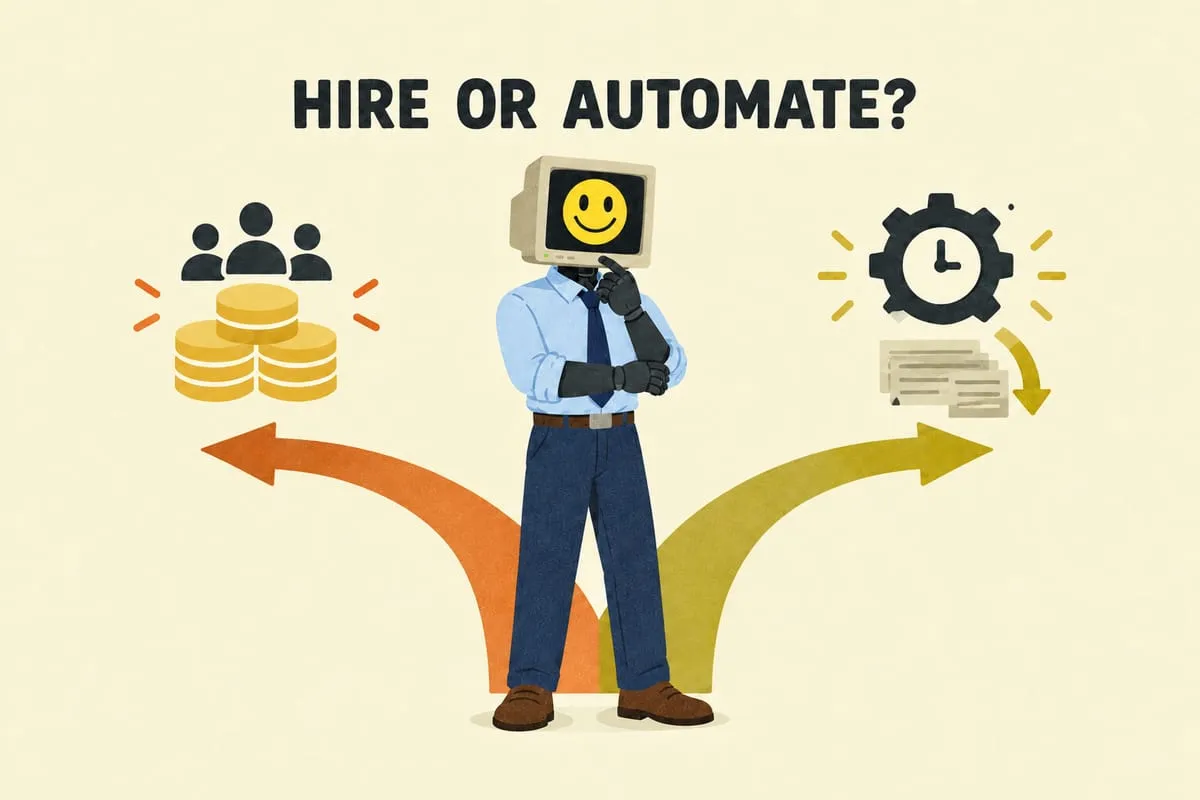
You’re working 60-hour weeks and your business is growing. Your instinct says hire someone. But before you post that job listing, let’s do the math.
Every growing business hits a fork in the road. You can’t handle the volume anymore. Something has to give. The default move is to hire, because that’s what businesses do when they need more capacity. But there’s another option that most business owners don’t consider carefully enough.
The Real Cost of an Employee in Canada
A hire for operations or admin work typically costs $45,000 to $70,000 in salary. But salary is just the start.
Add employer CPP and EI contributions. Add benefits (health, dental, maybe RRSP matching). Add equipment (computer, desk, software licenses). Add training time, because it takes 3 to 6 months before a new hire is fully productive. Add management overhead, because someone needs to onboard, supervise, and review their work. Add the risk of turnover, because if they leave after a year, you start the whole process over.
The all-in cost of an employee in Canada is typically 1.3 to 1.5 times the salary. For a $55,000 hire, you’re really spending $70,000 to $80,000 per year. Every year.
The Real Cost of Automation
Automation has a different cost structure. There’s an upfront investment and an ongoing management fee.
These are typical ranges for our engagements: discovery ($1,500 to $5,000) to map your processes and design the solution, from a short Process Assessment to a full Discovery Sprint. Build ($5,000 to $35,000 or more) for the actual automation. A single workflow sits at the low end. A build that connects several systems and uses AI to read your documents sits at the top. Managed automation ($1,000 to $4,000 per month) for ongoing monitoring, maintenance, and improvements.
Year 1 total: roughly $17,000 to $80,000 depending on scope. Every build includes 60 days of monitoring, so year one carries about ten months of the management fee. That’s comparable to or less than the all-in cost of an employee.
But here’s the difference: year 2 is just the monthly management fee ($12,000 to $48,000 per year). There’s no additional build cost. No re-training. No risk of turnover. The automation doesn’t call in sick, doesn’t need vacation, and handles 10 orders or 1,000 orders the same way.
What Automation Does Better Than People
Repetitive data entry. Document processing. Moving data between systems. Rule-based decisions (if the order is over $500, apply this discount tier). Processing at 2 AM without overtime. Perfect consistency, no “bad days.” Instant scalability.
These are tasks where a human is essentially acting as a slow, error-prone computer. Not because the human is bad at their job, but because the job shouldn’t be a human’s job in the first place.
What Humans Do Better Than Automation
Relationship building. Creative problem solving. Handling truly novel situations. Empathy and customer care. Complex negotiations. Strategic thinking. Physical tasks.
These are the things the business owner, and eventually their team, should be freed up to do. They’re also the things that actually grow a business.
The Honest Answer
For most growing businesses, the right move is to automate the repetitive operational work and eventually hire for the strategic and relationship roles.
Automation doesn’t replace your team. It replaces the work your team shouldn’t be doing.
We see this pattern regularly: small distribution teams of three or four people, processing well over a million dollars in annual orders, spending dozens of hours per week on manual order processing, invoice creation, and supplier coordination. When that operational work gets automated, it frees up the majority of those hours for growth, customer relationships, and strategic work. Read more: What Automation Looks Like for a 3-Person Distribution Business
When these businesses eventually hire, that person can focus on sales and customer care, not copying data between PDFs and QuickBooks.
When Hiring Is the Better Choice
Automation isn’t always the answer. If the work is primarily relationship-based (sales, account management, customer success), hire a person. If the work requires physical presence (site visits, deliveries, installations), hire a person. If the work is genuinely different every time with no repeatable pattern, hire a person.
And if the work is a mix of repetitive and strategic, consider automating the repetitive parts first. Then your new hire can focus on the work that actually needs a human brain. Read more: The 5 Signs Your Business Has Outgrown Manual Processes
What to Do Next
If you’re at this decision point, the first step is understanding exactly where your time goes. Which tasks are repeatable? Which ones are high-volume? Which ones are bottlenecking your growth?
That’s what our discovery process is designed to figure out. We’ll map your workflows, identify the automation candidates, and do the math with your actual numbers. No commitment to build. Just clarity on whether automation, hiring, or both makes sense for your situation.