Oscar’s office is not what Sam expected.
She expected glass and chrome. A big screen with dashboards. Maybe a robot in the corner. Instead, it’s a modest space in London, Ontario, with a whiteboard that takes up an entire wall, a desk buried in coffee cups, and an eraser worn down almost to the plastic.
Oscar gestures to the whiteboard. “I want to try something. You told me on the phone that you tried three things: hiring, buying software, and having your IT guy rig up Zapier and ChatGPT. All three failed. But they didn’t fail for the same reason. And I think you already know why, even if you haven’t put words to it yet.”
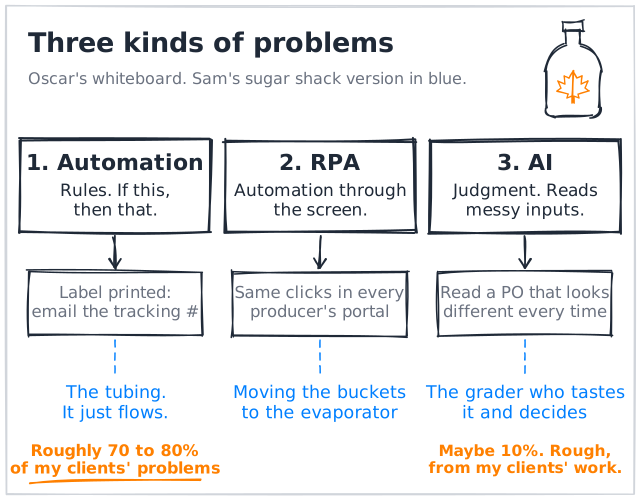
He writes three problems on the whiteboard:
Problem 1: When a shipping label is created, someone needs to email the tracking number to the customer.
Problem 2: Every Tuesday, someone reads the counts off Ray’s inventory sheet and types the barrel order into each Quebec producer’s web portal. Same screens, same clicks, every single time.
Problem 3: A PDF purchase order arrives and someone needs to read it, understand what it’s asking for, and extract the line items, even though every customer’s PO looks different.
“Three problems,” Oscar says. “If you had to solve each one, what would you reach for?”
Sam thinks. “I mean… Zapier for the first one? It’s just a trigger. When this happens, do that.”
“Good. What about the second?”
“Some kind of… I don’t know, a macro? Something that clicks through the screens the same way every time?”
“Close enough. And the third?”
Sam pauses. “That’s the one where you’d need AI. Because the document is different every time.”
“You just described the whole landscape in about thirty seconds,” Oscar says. “Most vendors take forty minutes to sell you a platform that blurs all three together.”
He labels them on the board:
Problem 1: Automation. Rules. If this, then that. Simple, cheap, usually the right starting point.
Problem 2: RPA. Automation through the screen. A software robot that mimics what a human clicks, in the same order, every time. More complex, but still predictable.
Problem 3: AI. Judgment. Reading, interpreting, deciding, even when the input changes.
“Which of these did CloudSyncPro promise to solve?”
“All of them. They said it would handle everything.”
“And Dave’s zap?”
“The third one. The AI one.” Sam stops. “So the AI was the…” She doesn’t finish. She isn’t sure it was.
“Do you still have access to it?” Oscar asks.
She does. She opens her laptop and pulls up the zap’s history, and Oscar scrolls to the Sunday night. Each run is a list of steps. On the first run, the ChatGPT step reads PO #4721: 24 cases Grade A Amber, 12 cases Grade A Dark. Correct. Confirmation: sent. Then, at 2:14 AM, the carrier step turns red, and Dave’s error path sends the email back into the inbox.
The next run starts from the top. Same PO. Same correct reading. Confirmation: sent. Carrier: red. Eight runs for one purchase order, then eight more for the next one.
Sam scrolls through the ChatGPT steps. Quantities right. Grades right. PO numbers right. Every time.
“It read them all correctly,” she says. “Nothing checked whether the customer already had a confirmation. Nothing told it to stop when the carrier went down.” She sits back. “Nobody was watching.”
“Zapier can run a solid workflow if somebody designs it to,” Oscar says. “ChatGPT can read a PO. What nobody built was the part in between.” He looks at the screen a moment longer. “I’ve built one of those myself. Years ago, a bot for an online game. It fought scorpions all night while I slept. Fight, heal, cook, fight. One night a moderator walked up and tried to talk to it, and it kept fighting scorpions. Nobody had told it about moderators, and I was asleep.”
“What happened?”
“I got banned.”
Sam looks at the board. Then she says something that surprises both of them.
“It’s like the sugar shack. The tubing is automation. It just flows. The person connecting the buckets to the evaporator is RPA, doing the same physical steps every time. And the grader, the one who tastes the syrup and decides what grade it is, that’s AI.”
Oscar picks up the marker and draws a maple syrup bottle next to the three problems. “Keep going.”
“So CloudSyncPro tried to do all three at once, without understanding which parts we actually needed.”
“And Dave’s zap?”
“A good grader,” Sam says, “on the end of tubing with no shut-off valve.”
Oscar caps the marker. “Across my clients, roughly 70 to 80 percent of the pain points turn out to be Problem 1. Rules and triggers. AI is the right answer maybe 10 percent of the time. Real systems mix all three. Where a system has a supported API or a native integration, you use that. Screen automation is for the systems that don’t. The trick is matching the tool to the problem, not buying the biggest tool and hoping it fits everything.”
“So most of my problems are the cheap end?”
“For most of your problems, yeah. Matching payments to invoices at month-end? That’s mostly rule-following, with judgment on the messy ones. Medium complexity. Your PO data extraction? That’s AI territory, because every customer sends a different format. But your tracking number emails? That’s a simple trigger: when a shipping label is created, email the tracking number to the customer. Hours of work, not weeks.”
“I’ve been paying Lisa to do that manually for years.”
“I know.”
Oscar pours two coffees from a machine in the corner and hands Sam one.
“What Dave built is an AI assistant with a trigger bolted on,” he says. “An assistant is what you have when you open ChatGPT and type a question. You ask, it answers, and then a person decides what to do with the answer. You’re still the one copying, pasting, deciding, and acting. You’re still the bottleneck.”
He sets his cup down. “An AI system is different. It reads the incoming purchase orders, extracts the line items, checks them against your customers and your prices, releases the order to the warehouse, and confirms with the customer. When the order ships, the invoice goes into QuickBooks. And around all of that, it has the boring parts the zap didn’t: error handling, monitoring, a log, and a person who sees the exceptions.”
Sam has used ChatGPT to draft emails and summarize reports. It helped, and the next day she did the same work again.
“I talked Dave into this,” she says. “He told me it wasn’t his trade.”
“He was right, and he told you before he built it. That’s a good IT guy. Keep him.”
“You say that like you’ve been one.”
“I was one. I started fixing computers at sixteen. Neighbourhood Nerd.”
Sam puts her coffee down. “Neighbourhood Nerd.”
“Nobody was ever confused about what they were getting.”
“Did the nerd have a van?”
“The nerd had a bicycle.” He says it like it was a perfectly good fleet. “It grew into YourTech. Small businesses, their computers and their networks. Dave’s job, more or less. Spend enough time under people’s desks and you start noticing what they do at them. The same numbers typed into three screens, all day. But asking your MSP to engineer an AI workflow is like asking your electrician to design the evaporator. Same building. Different trade.”
Sam hesitates, then opens the photos on her phone. “Lisa found this after the email thing. It’s Marcus’s ChatGPT. He’s our account rep.”
Oscar reads for a minute. Customer names. PO numbers. Line items with per-case pricing. He doesn’t make a joke this time.
“This matters more than the zap,” he says. “Everything pasted into a personal ChatGPT account goes to OpenAI under consumer terms. Unless he’s switched off a setting called ‘Improve the model for everyone,’ they can use it to train their models. Some of this looks like Henderson’s pricing. Is that under NDA?”
”…Probably.”
“Then tell Marcus today. No customer data in ChatGPT until we’ve written a policy. It’s one page. We’ll do it together.”
“I’ll tell him.”
“AI is good at reading messy documents, sorting things, and summarizing,” Oscar says. “It’s bad at being right every time, and it’s terrible at keeping secrets. And it can’t know what nobody told it. It doesn’t know that Mrs. Chen wants Amber even though she writes Dark. That lives in Lisa’s head. If you don’t teach it to the system, the system won’t know.”
The Golden Dragon order comes back to her. She typed what the paper said, too.
“So it’s not a replacement for Lisa.”
“It’s not a replacement for anyone. It’s a replacement for the boring parts of everyone’s job. The reading, the copying, the sorting. The judgment and the relationships stay human.”
Sam’s phone buzzes. She glances at it. It’s Lisa. She almost ignores it, but Lisa doesn’t call during business hours unless something is on fire.
“Sorry, one second.” She picks up.
Lisa’s voice is tight. “Henderson’s just called. They want a breakdown of last year’s order history by grade, by distribution centre, by month. Their procurement team needs it for a budget review.”
“Okay. How long will that take?”
“If I drop everything else? Two days. Maybe three. The data is split across QuickBooks, the Google Sheet, and that one spreadsheet from when we switched to the new carrier. I’ll have to cross-reference all three manually.”
Sam closes her eyes. “Do it. Henderson’s comes first.”
She hangs up. Oscar is watching her.
“That was Lisa. Henderson’s wants a report. It’s going to take her two days to pull together because the data is in three different places.”
“How long should it take?”
Sam opens her mouth. Closes it. “Five minutes. If our systems talked to each other, it should take five minutes.”
Before she leaves, Sam asks what happens next.
“I come out to Woodstock,” Oscar says.
Sam has paid for enough surprises this winter to ask the obvious question. “What does that cost?”
“Five thousand, plus HST. We call it a Discovery Sprint. I spend a day at MapleCo with Lisa and Ray and watch how the work actually happens. Then you get it in writing: every process mapped, every exception I can find, and a fixed price for each piece worth building.”
“So I pay you five grand to tell me what’s wrong with my business.”
“You pay me five grand to find out what you’re actually doing. You paid CloudSyncPro thirty to skip that part.” He shrugs. “The roadmap is yours either way. Hire me to build it, hire someone else, or put it in a drawer. I don’t guess at build prices on a sales call. That’s how you end up with a $15,000 connector nobody mentioned.”
Sam doesn’t have a comeback for that. She books it before she leaves.
Somewhere between London and Woodstock, Henderson’s report takes over the rest of her week. The note in her notebook that says talk to Marcus stays where it is.
The next week, Sam drives to Quebec to visit one of MapleCo’s longest-standing producers, a family operation near Portneuf that’s been supplying them since 2003.
She makes this trip once or twice a year. Usually it’s about pricing, quality, production forecasts. This time there’s a reason. After the Golden Dragon mess and a winter of short counts on Ray’s inventory sheet, she wants extra barrels of Grade A Amber set aside from this year’s run, and that’s a conversation you have in person. It’s mid-March. The sap is running.
The sugar shack has changed since her last visit. New tubing. New monitoring equipment. The owner, Luc, walks her through the upgrades.
“See this?” He points to a small screen mounted near the mainline. “Every line has a vacuum sensor on it. If a line loses vacuum, I get a notification. I don’t walk the bush every morning checking tubes anymore. The system tells me where the problems are, and I go fix those.”
“How many taps do you run?”
“Twelve thousand. Used to be four thousand. With the old system, I couldn’t manage more than four thousand because I was the monitoring system. I had to physically check everything. Now the system checks everything and I handle the exceptions.”
Sam watches the sap flow through clear tubing into the collection tank. She watches it get pumped to the evaporator. She watches the operator, Luc’s daughter, monitor a screen that shows temperature, density, and flow rate in real time. The daughter adjusts one dial, checks a reading, and goes back to her coffee.
“How many people run this now?” Sam asks.
“Three during sap season. Used to be seven. But the three aren’t doing less work. They’re doing different work. Better work. My daughter is a better grader than I ever was because she has time to actually grade instead of spending half her day walking tubing lines.”
Sam drives back to Woodstock the next morning. Nine hours. She doesn’t turn on the radio. She doesn’t make phone calls.
She keeps thinking about Luc’s sentence: I couldn’t manage more than four thousand because I was the monitoring system.