Chapter 4: The Mirror
Oscar spends a day watching how MapleCo actually works, and what he finds is very different from what Sam assumed.
Want to keep reading?
Enter your email to unlock all chapters and get the complete book as a PDF.
Get the Full Book
We'll email you the complete PDF and unlock all chapters to read right here on the site.
You're in! All chapters are now unlocked.
We've also emailed you the PDF of Stop Being the Glue. Check your inbox.
Download the PDF NowSomething went wrong. Please try again.
Book download is not currently available. Please try again later.
Oscar shows up at MapleCo on a Wednesday morning at 8:15, fifteen minutes before Lisa arrives.
He brings a notebook. Not a laptop, not a tablet, a spiral-bound notebook with a pen clipped to the cover.
“I want to watch,” he says. “The process that actually happens, not the one you’d describe if I asked. There’s always a difference.”
Sam offers him coffee and a chair near Lisa’s desk. When Lisa arrives at 8:30, Sam introduces Oscar as “someone who’s going to watch how we work for a day. Just pretend he’s not here.”
Lisa gives Sam a look that says I will absolutely not pretend he’s not here. But there’s something else in the look too. Something harder. Lisa has been through this before. Three years ago, a “process consultant” watched her for a day, wrote a report that described her work incorrectly in fourteen different places, and recommended software that didn’t connect to QuickBooks. The software was purchased. It didn’t work. Lisa spent two months cleaning up the mess. Nobody apologized.
She sits down and starts her morning routine without a word.
Oscar watches.
At 8:37, Lisa opens her email. There are fourteen new messages since yesterday. She scans the subject lines, mentally sorting: purchase order, purchase order, tracking request, payment confirmation, spam, purchase order, question from a customer about grade availability, purchase order, supplier quote, spam.
She opens the first PO email. It’s from Henderson’s. A PDF is attached. She downloads it, opens it, and begins reading.
Oscar leans forward. “Talk me through what you’re doing right now.”
“Processing a purchase order.” Lisa doesn’t look up.
“Can you walk me through the steps?”
“I open the email. I download the PDF. I enter the data into QuickBooks. I update the tracker.” Her voice is flat. Efficient. This is the version she gives consultants. The clean version. Three sentences that describe a fifteen-step process.
Oscar waits a beat. Then: “What about the pricing?”
Lisa pauses. She looks at him for the first time. That’s not a consultant question. Consultants ask about software and systems. They don’t ask about pricing.
“What about it?”
“Do you check it every time, or just for certain customers?”
Lisa glances at Sam. Sam nods.
“Every time,” Lisa says. Her voice is still careful, but it’s no longer the three-sentence version. “Henderson’s is on a contract price sheet, but the prices changed in February and not all the old POs in the system have been updated. So I cross-reference against the master price list.” She opens a Google Sheet in another tab. “This is the price list. It was updated last month. But some customers are still on the old prices because we haven’t sent them the new contracts yet.”
“How many price lists are there?”
Lisa pauses. “Well, there’s the master list in Google Sheets. There’s a version in QuickBooks that’s supposed to match but doesn’t always. And then Henderson’s has their own pricing agreement, which is different from the master list because they get volume discounts.”
Oscar writes something in his notebook and underlines it.
By 10:30, Oscar has watched Lisa process four purchase orders. Each one took between 12 and 18 minutes. Each one involved opening at least three different applications. Each one required at least one cross-reference to verify a price, a customer code, or a product description.
He’s also watched Lisa answer two phone calls (a customer asking about delivery status, which required Lisa to look up the order in her spreadsheet, then check the carrier website), respond to three emails (a supplier confirming a shipment date, a customer requesting an invoice copy, and the carrier asking her to resend a bill of lading she already sent yesterday), and rescue a stuck printer.
In two hours, Lisa has processed four orders and handled six interruptions.
Oscar asks to walk the warehouse. Sam hesitates, but agrees.
Ray meets them at the loading dock with the warmth of a man being introduced to his fourth consecutive consultant. “Morning,” he says. He does not ask Oscar’s name.
Oscar doesn’t seem bothered. He watches the warehouse for twenty minutes without saying anything. He watches a picker read a packing slip, cross-reference it against a handwritten note on the whiteboard, walk to the wrong aisle, walk back, check the note again, and then pull the correct pallet.
“That note on the whiteboard,” Oscar asks Ray. “How often does it change?”
“Whenever someone moves inventory and remembers to update it.” Ray pauses. “So, sometimes.”
“And when it’s wrong?”
“Then somebody ships the wrong thing and I get a phone call about it.”
Oscar writes in his notebook. Ray watches him write and says, “You going to fix that with an app?”
“I don’t know yet,” Oscar says. “I’m still figuring out if you have a whiteboard problem or a systems problem.”
Ray looks at Oscar for a long moment. “First guy who’s asked that,” he says.
Back in the boardroom, Oscar draws a timeline on the whiteboard.
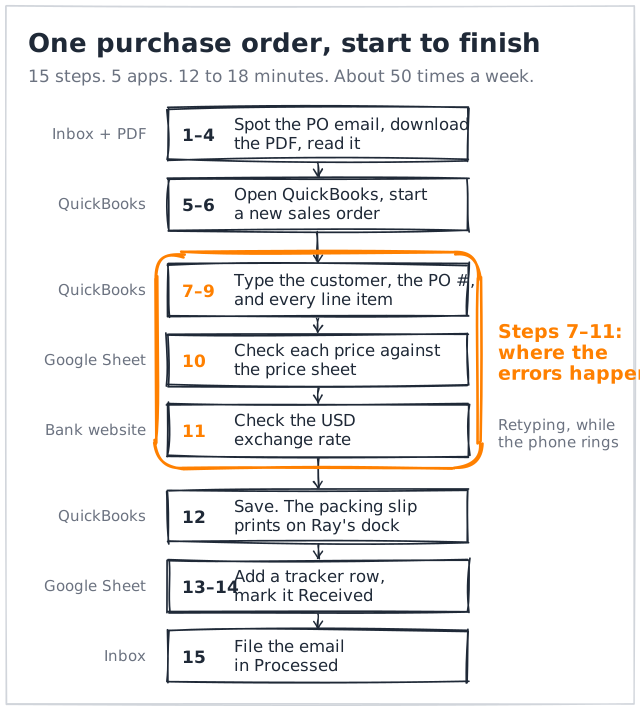
“Here’s what I just watched,” he says. “One purchase order, start to finish.”
He maps it out, step by step:
- Email arrives with PO attached
- Lisa opens email, identifies it as a PO
- Lisa downloads the PDF
- Lisa opens the PDF and reads it
- Lisa opens QuickBooks
- Lisa creates a new sales order
- Lisa types the customer name
- Lisa types the PO number
- Lisa types each line item (product, quantity, price). For Henderson’s, that’s three line items
- Lisa cross-references the price against the Google Sheet
- Lisa checks the exchange rate (Henderson’s pays USD)
- Lisa saves the sales order
- Lisa opens the Google Sheet tracker
- Lisa adds a new row with the PO details and marks it “Received”
- Lisa moves the original email to a “Processed” folder
“Fifteen steps,” Oscar says. “And that’s a clean one. No exceptions, no questions, no phone calls in the middle.”
Sam stares at the whiteboard. She knew Lisa entered POs, but she’d never seen it mapped out like this.
“Now multiply that by fifty to sixty orders a week,” Oscar says.
At 15 minutes per PO, and 50 POs per week, that’s 12.5 hours. Just for initial entry. Not counting tracking, invoicing, payment matching, or any of the dozen other manual steps that follow.
He circles steps 7 through 11. “This is where errors happen. Lisa’s careful. But everyone makes mistakes when they’re copying data for the twentieth time that day while also answering the phone.”
Sam thinks about Mrs. Chen. The wrong grade. A single field, and a rule nobody wrote down.
Lisa hasn’t said a word since Oscar started drawing. At lunch she goes out to the parking lot and sits in her car. Sam can see her from the boardroom window. Ten minutes later Lisa comes back in and processes the next PO.
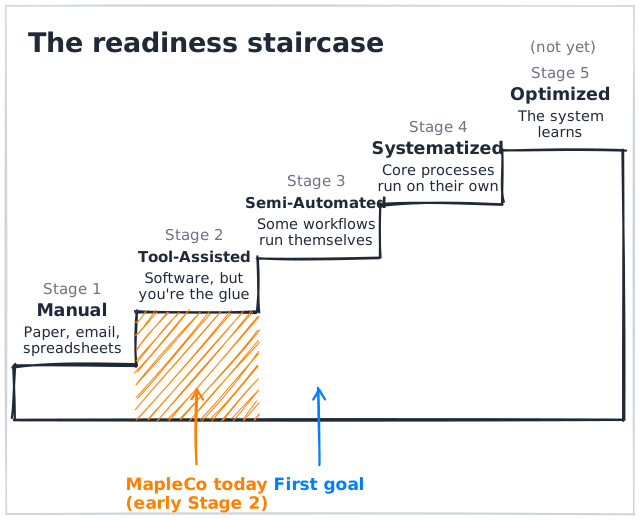
Oscar flips to a new section of the whiteboard and draws a staircase of five steps. He labels the bottom one Manual and the top one Optimized. Then he talks about only two of them.
“Stage 2 is tool-assisted,” he says. “You have software, QuickBooks, maybe a CRM, but people do all the connecting work between the systems. Stage 3 is semi-automated. Some workflows run on their own, and people kick things off or handle the exceptions.” He holds out the marker. “Where’s MapleCo?”
Sam considers. QuickBooks. A Google Sheet tracker. A carrier website. The producers’ portals. She’s not running things on paper.
“Stage 3,” she says. “Maybe late Stage 2. We have all these systems. They just don’t talk to each other well.”
“That’s the answer I get from almost every owner. It’s almost always a stage too high.”
“What do you mean?”
“Having software isn’t the same as being tool-assisted. Being tool-assisted means the tools are actually helping. Lisa opens five applications to process one purchase order. She’s not assisted by those tools. She’s employed by them. She works for QuickBooks, not the other way around.”
Sam opens her mouth to argue. They have systems. They’re not some paper-and-fax operation.
Then she thinks about the six browser tabs, and the three price lists that don’t agree, and Luc’s sugar shack, where three people run twelve thousand taps. MapleCo has thirty people and fifty-some orders a week, and she still can’t take a vacation.
She takes the marker and puts a mark on the low end of Stage 2.
He taps Stage 3. “That’s where we’re going first. Lisa goes from data entry to exceptions. You go from firefighting to approving.”
“The next step,” Oscar says, “is documenting how your business actually works. The real version, workarounds and all.”
Sam shifts in her chair. “I kind of thought that’s what you just did. Watching Lisa.”
“That’s one process. You have dozens, and every one of them has exceptions, workarounds, and steps that only one person knows about.”
He tells Sam about a construction company he worked with. The owner said their invoice processing was “basic.” It turned out they had seven different approval workflows depending on the project, the contractor, and whether the amount was above or below $10,000. Two of those workflows existed only in the office manager’s head.
“So Lisa’s workarounds are the process documentation,” Sam says.
“Lisa’s workarounds are the business. Everything else is what you assumed.”
Oscar gives Sam homework.
“Before our next meeting, I want you and Lisa to do something. Pick your three most painful processes, the ones that eat the most hours and create the most errors. For each one, I want you to write down every single step. Not what the software manual says. What actually happens.”
He gives her a framework:
Who does each step? What system or tool do they use? What data are they moving, and from where to where? How long does it take? Where does it break? What are the common errors or exceptions? What’s the workaround? When something goes wrong, what does Lisa actually do?
“Don’t try to make it pretty,” he says. “I want the ugly version. The one where step four is ‘call Sam because she’s the only one who knows the password to the supplier portal’ and step seven is ‘check if the exchange rate looks right based on vibes.’”
Sam laughs for the first time in weeks.
“I’m serious,” Oscar says. “The ugly version is the valuable one. If you give me the clean version, I’ll build the wrong thing.”
On his way out, Oscar stops at the shelf by reception. Three bottles stand in a row, each a shade darker than the last.
“What’s actually different?”
Sam takes a sleeve of plastic tasting spoons from the drawer underneath. She keeps them for trade shows. She holds each bottle up to the window before she pours. “They grade it by how much light gets through. Golden is early in the season. Delicate. Amber is what most people picture. Dark comes later, and it’s strong.”
He tastes all three, then goes back to the Dark. “That one.”
“For what?”
“Pancakes. Saturday mornings.”
“Then Amber. Dark’s for baking. On a pancake, it shouts. Golden’s our niche grade. Chefs like it. Everybody else pours it on pancakes and wonders where the flavour went.”
He tries the Amber again, slower. “Okay. Amber.”
She sends him home with a bottle and won’t let him pay for it.
Passing the order desk, he thanks Lisa for her time. “Sure,” she says, without looking up from her screen.
Three days later, Sam calls Oscar.
She’s calling because she’s frustrated. Henderson’s report took Lisa two and a half days. She rushed a batch of POs between calls and made three typos, one of them on a Henderson’s order. A barrel delivery from Quebec showed up two days late, Ray ran out of Amber, and nobody noticed until a customer called to ask where their order was. And Sam has spent the last week answering questions, showing Oscar around, and doing homework instead of fixing any of these things.
“Oscar, I need to be honest with you. I’m paying you to fix my business and so far all we’ve done is talk about my business. When does the fixing start?”
“What would you fix first?” Oscar asks.
“The PO processing. Obviously.”
“Then which customers send POs as PDFs? Which put the order in the body of the email? Which still fax? If a PO has a product code nobody recognizes, should the system reject it, hold it for Lisa, or guess?”
“Lisa would know.”
“Lisa answers those in her head fifty times a week. If I don’t know the answers, I build the clean version, and the clean version breaks on the first order that isn’t obvious. Every contractor who disappointed you built the clean version.”
“I know why you’re asking. You’ve told me.” Sam is pacing her office now. “What you haven’t told me is how I’d know any of this is going somewhere. From here, it’s a lot of questions and a notebook I’ve never seen inside. And Greg Hollis has a calendar.”
Oscar doesn’t answer right away.
“That’s fair,” he says. “I’ve explained why we need the questions. I haven’t shown you where they go.”
“One more session: you and Lisa, the homework, the ugly version. Then I write the roadmap, and you get it on paper. Then you and I sit down and pick what gets built first. You get the deciding vote. And from now on, when something’s done, you hear it from me before you have to ask.”
Sam writes three words on the back of an envelope: Lisa. Roadmap. Pick.
It’s still another week before anything changes. She hangs up and calls Gerald.
“Your automation guy is driving me crazy. I told him he was all questions, and he agreed with me.”
“Is that a problem?” Gerald says.
“I’ll let you know in a week.”
That night, Sam and Lisa stay late.
They start with purchase order processing, the obvious one. Lisa describes each step while Sam writes it on a legal pad. It takes longer than expected. There are steps Sam didn’t know about. There are judgment calls Lisa makes unconsciously. She can tell from the formatting of a PO which customer it’s from before she even reads the header. She knows which Quebec producer will still squeeze in a barrel order after the Tuesday noon cutoff, and which one never will. She knows that Grade A Golden has a longer lead time than Amber or Dark. She mentions that Golden Dragon’s “Dark” means Amber the way someone mentions the weather. Sam, who learned that rule the expensive way, stops writing for a second.
None of this is written down anywhere. It lives in Lisa’s head.
They map out invoicing next. Halfway through credit notes, Sam’s phone buzzes. Marcus: Quick one. Toronto group wants last spring’s Amber price before their call at nine.
“Lisa, can you pull up…”
Lisa is already pushing the legal pad aside and reaching for her mouse.
Sam’s thumbs are already typing Lisa’s on it. She looks at the pad and deletes the message. “Leave it.” Then she texts Marcus: On your desk by 8:30. That means coming in at seven and doing it herself. She turns the phone face down. “Credit notes.”
Lisa pulls the pad back.
Then payment matching. By 8 PM, they have three legal pads full of messy, honest process documentation.
“This is kind of terrifying,” Sam says, looking at the pages. “If you got hit by a bus tomorrow, none of this knowledge would survive.”
“That’s called key-person risk,” Lisa says. Then, quieter: “I can keep fixing this manually, but that’s not the same as this being fine.”
Through the wall, one of Ray’s forklifts beeps its way backward across the warehouse floor. The night crew is loading tomorrow’s trucks.
“Can I ask you something?” Sam says. “The day Oscar was here. At lunch, you sat in your car.”
Lisa caps her pen. “Ten minutes.”
“Why?”
Lisa looks at the legal pads for a while before she answers. “Eight years, Sam. Eight years making sure this place doesn’t fall apart. And he wrote my whole job on a wall in fifteen lines. Like he was getting it ready to hand to a toaster.”
Sam wants to say the right thing. She doesn’t know what it is yet, so she says nothing.
“I’m not going anywhere,” Lisa says. “I just wanted you to know it felt like that.”
Sam writes Lisa at the top of a fresh page. She underlines it twice. It’s the only thing on the page.
Want the full book as a PDF?
All 7 chapters plus the 90-Day Playbook, the Process Discovery and Sam's Math worksheets, the Readiness Staircase self-check, Lisa and Ray's Questions, and Sam's AI Policy template. Free.
Take the book with you
The full PDF, with all 7 chapters, the 90-Day Playbook, the worksheets, and Sam's AI Policy template. Read it offline, or print the worksheets for your team.
Who's your Lisa?
Every business has someone who carries the rules nobody wrote down. We'll get that knowledge out of their head and into a system, so the business keeps running when they take a vacation.