How to Choose a Single Automation Partner You Can Actually Trust Long-Term
The right automation partner saves you hundreds of hours. The wrong one costs you both time and money. Here's what actually matters beyond hourly rate.


The right automation partner saves you hundreds of hours over the next few years. The wrong one costs you both time and money. And the difference usually isn’t obvious from a proposal.
Most companies evaluate on price alone. That’s why they end up cycling through vendors every 12 months. Here’s what actually matters.
Do they want to understand your business first?
A partner who jumps straight to “give me the requirements” is a contractor. Look for someone who asks about your goals, your team, and your pain points before they talk technical approaches. If they skip discovery, they’re optimizing for their speed — not your outcome.
Ask them: What does your discovery process look like? What do you need to know about our business before you start?
Related: Why discovery matters more than a quick build →
Can they handle varying complexity?
Your needs will range from simple workflows — an email trigger when a HubSpot deal closes — to complex integrations like syncing Procore with QuickBooks Online or pulling data out of Sage 300. If they can only do simple stuff, you’ll outgrow them. If they only want enterprise projects, your quick wins will sit in a queue.
Ask them: Can you show me examples of both simple and complex projects?
Do they build AND support?
Non-negotiable. Automations aren’t “set it and forget it.” APIs change. Platforms update. Your business evolves. A partner who builds and walks away is leaving you with a system you can’t maintain.
A partner who maintains what they create has skin in the game to build it right the first time.
Ask them: What does post-deployment support look like? What’s your response time for production issues?
Do they understand your industry?
Automation for financial services is different from automation for construction. Industry knowledge means they understand your compliance requirements, data sensitivity, and seasonal patterns without you explaining it from scratch.
Ask them: Have you worked with companies in our industry? What compliance considerations do you typically handle?
Related: One automation partner, one architecture, one point of accountability →
Are they transparent about pricing?
Your partner should clearly explain how they charge, what’s included, and what triggers additional costs. No surprises. A good partner also helps you understand ROI — not just “here’s what it costs” but “here’s when you break even.”
Ask them: How do you structure pricing? What happens if a project takes longer than estimated?
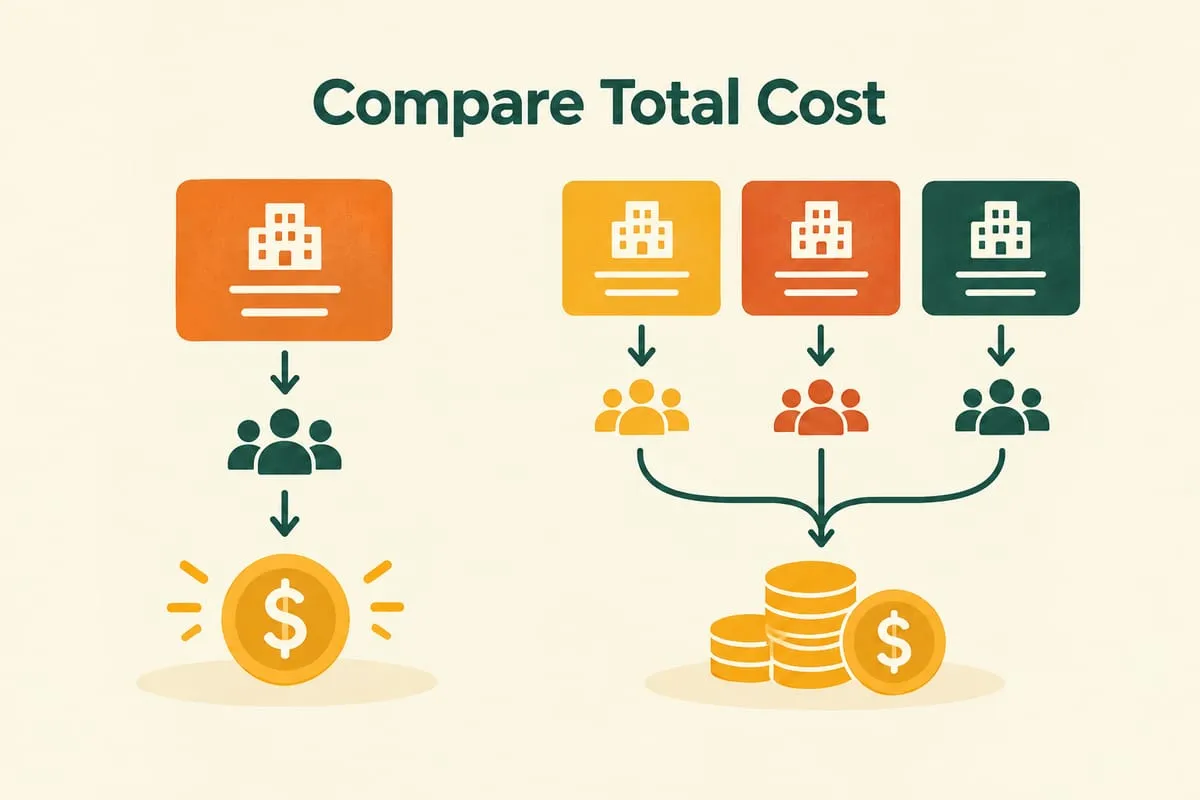
Related: The real cost of managing multiple automation contractors →
Can they scale with you?
What happens when you need five automations built simultaneously? Or when something breaks on a Friday and your contractor is on vacation? A good partner has the capacity to grow with you without you having to find and manage additional vendors.
Ask them: What’s your team’s capacity? How do you handle scaling up?
Do you actually like working with them?
You’ll be working with this partner for years. If the first call feels like pulling teeth, it won’t get better. Trust your gut. A great partner should feel like an extension of your team.
Red flags
- They quote a price without understanding your business
- They can’t explain pricing simply
- No post-deployment support
- Unrealistically short timelines
- No references or case studies
- They only care about what you want automated, not why
A note on when this doesn’t apply
If you only need a small standalone task — a one-off Zapier workflow that doesn’t touch anything else — a freelancer might be perfectly fine. And if you have a strong internal automation lead who owns the architecture, multiple specialists can work under that coordination. The advice here is for the more common situation: a growing company without a dedicated automation manager, where the business owner ends up being the glue between vendors.
The cheapest option is rarely the best value. What matters is finding a partner who understands your business, handles your range of needs, supports what they build, and makes your life easier.
Want to see how DigitalStaff measures up? Put us to the test.