The Real Cost of Managing Multiple Automation Contractors
The cheapest automation vendor is almost never the cheapest option. Here's the full cost picture most businesses miss when comparing rates.

The cheapest automation vendor is almost never the cheapest option.
When you’re comparing proposals, rate is the first thing you look at. Vendor A charges $80/hour. Vendor B charges $150/hour. The math seems obvious. But that math is incomplete.
There’s a difference between vendor cost and total cost. Most businesses only look at vendor cost.
The costs you don’t see
Every automation engagement has visible costs — the ones on the invoice — and invisible costs that your business absorbs:
- Your time managing the vendor: meetings, emails, reviews, answering questions
- Coordination time between multiple vendors — you become the translator between teams that don’t talk to each other
- Ramp-up time — every new vendor needs weeks to learn your systems, your processes, your quirks
- Error remediation — when something breaks and you have to figure out whose automation caused it
- Maintenance fragmentation — three vendors means three different codebases and three different points of contact for fixes
The invisible costs are where the real money goes.
A realistic comparison
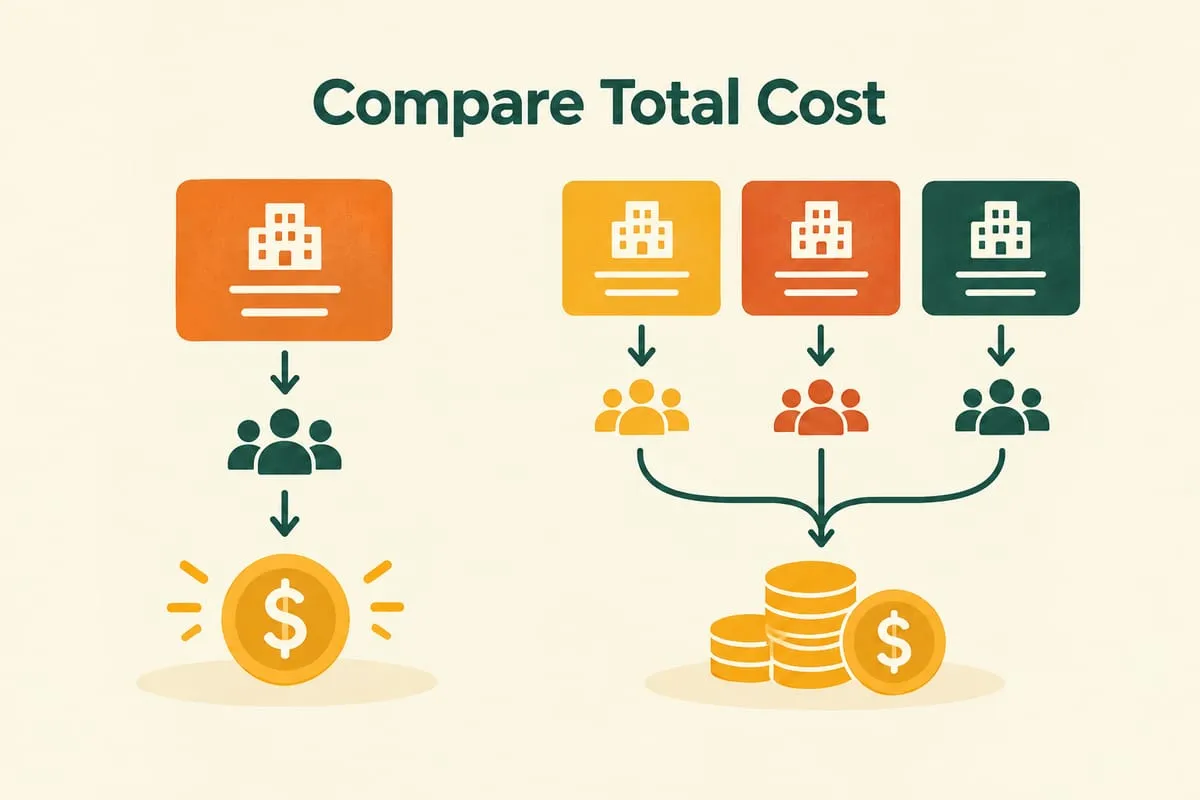
Three independent contractors at $80–100/hour. One builds your HubSpot onboarding flow. Another syncs deals to QuickBooks Online. A third automates your Asana project creation. Total build cost: ~$7,000. Looks great on paper.
But add your coordination time: 5 hours/week across a two-month build period. At $100/hour, that’s $4,000 of your time. The QuickBooks sync breaks because the HubSpot contractor changed a field the other contractor was reading — rework costs $1,500. After launch, one contractor is slow to respond. Another disappears after six months.
Total cost after 6 months: north of $15,000 for work that looked like $7,000.
One integrated partner at $120–150/hour. Higher rate. But one point of contact, one architecture, one team that designed the HubSpot-to-QuickBooks-to-Asana flow as a single system. Your coordination time drops to near zero. No conflicts between builds. Maintenance is unified.
Total cost after 6 months: often comparable or lower. The invoice is higher. The total cost isn’t.
Related: When to consolidate your automation vendors →
The compounding knowledge advantage
Your first project with any vendor is the slowest. They’re learning everything from scratch.
By project three or four, a good partner builds faster, makes fewer mistakes, and proactively suggests improvements. They know your HubSpot field structure. They know which QuickBooks classes map to which service lines. They know not to schedule maintenance during your end-of-quarter crunch.
Every time you bring in a new vendor, you pay the learning-curve tax again. Same rate, less output, more of your time explaining context.
The duplication problem nobody catches
Here’s one that comes up often: two vendors independently build logic that does the same thing.
Vendor A builds a workflow that checks whether a HubSpot contact has a valid email before creating a QuickBooks invoice. Vendor B, working on a different project, builds their own email validation check because they don’t know Vendor A’s already exists. Now you’re maintaining two versions of the same logic in two different systems. When your email validation rules change — say you start accepting a new domain — you have to remember to update both. Miss one, and you get inconsistent behavior that’s hard to trace.
With one partner, that shared logic gets built once and reused. Nobody duplicates work they’ve already done.
When you compare automation vendors, compare total cost of ownership — not just the invoice. Factor in your time, coordination overhead, error risk, and long-term maintainability.
The vendor with the lowest rate is not always the lowest cost.
We build value case analyses for every project, showing the real ROI. Want to see what that looks like for your business?