What Is AI, Really? A No-BS Guide for Business Owners
AI explained in plain English for business owners. No jargon, no hype, no Terminator references. Just what AI actually does and why it matters for your business.

Last week I was on a call with a business owner who told me, “I keep hearing I need AI, but honestly, I don’t even know what it is. I picture robots. Am I wrong?”
He’s not wrong for being confused. The term “AI” gets thrown around so loosely it could mean anything from a chatbot to a self-driving car to the robot from The Terminator. That’s not helpful when you’re trying to make smart decisions about where to spend your money.
So let’s fix that. No jargon, no hype. Just a straight explanation.
Forget the movies. Here’s what AI actually is.
AI is software that makes decisions or predictions based on patterns it learned from data.
That’s it. That’s the whole thing.
When your email app suggests “Sounds good, thanks!” it’s not reading your mind. It’s seen millions of email conversations and learned that when someone says “Does Tuesday work?” a common reply is some version of “yes.” Pattern matching at scale.
When a bank flags a suspicious transaction on your credit card, it’s not thinking “hmm, that looks shady.” It’s analyzed millions of transactions and learned that a $4,000 purchase at 3 AM from a country you’ve never visited doesn’t fit your pattern.
When AI reads an invoice and pulls out the vendor name, total, and due date, it’s not “understanding” the document the way you would. It’s been trained on thousands of invoices and learned where those pieces of information typically live.
Pattern matching. That’s the core of it.
”But what about the Terminator?”
There are two types of AI. Narrow AI is what exists today. It does one thing well. It reads invoices. It answers customer questions. It flags fraud. It can’t do anything outside the specific task it was built for.
General AI is the movie stuff — a machine that thinks like a human across any situation. This does not exist. It’s not close to existing.
Every AI tool you’ll encounter in your business is narrow AI. A very fast, very focused tool that’s excellent at one specific job and completely useless at everything else. You can stop worrying about the robot apocalypse.
What makes AI different from regular software
You might be thinking, “My accounting software also pulls totals from invoices. Is that AI?”
Traditional software follows rules. Someone writes code that says: “If the word ‘Total’ appears, grab the number next to it.” That works great until someone sends you an invoice that says “Amount Due” instead, or puts it on a different line. The software breaks.
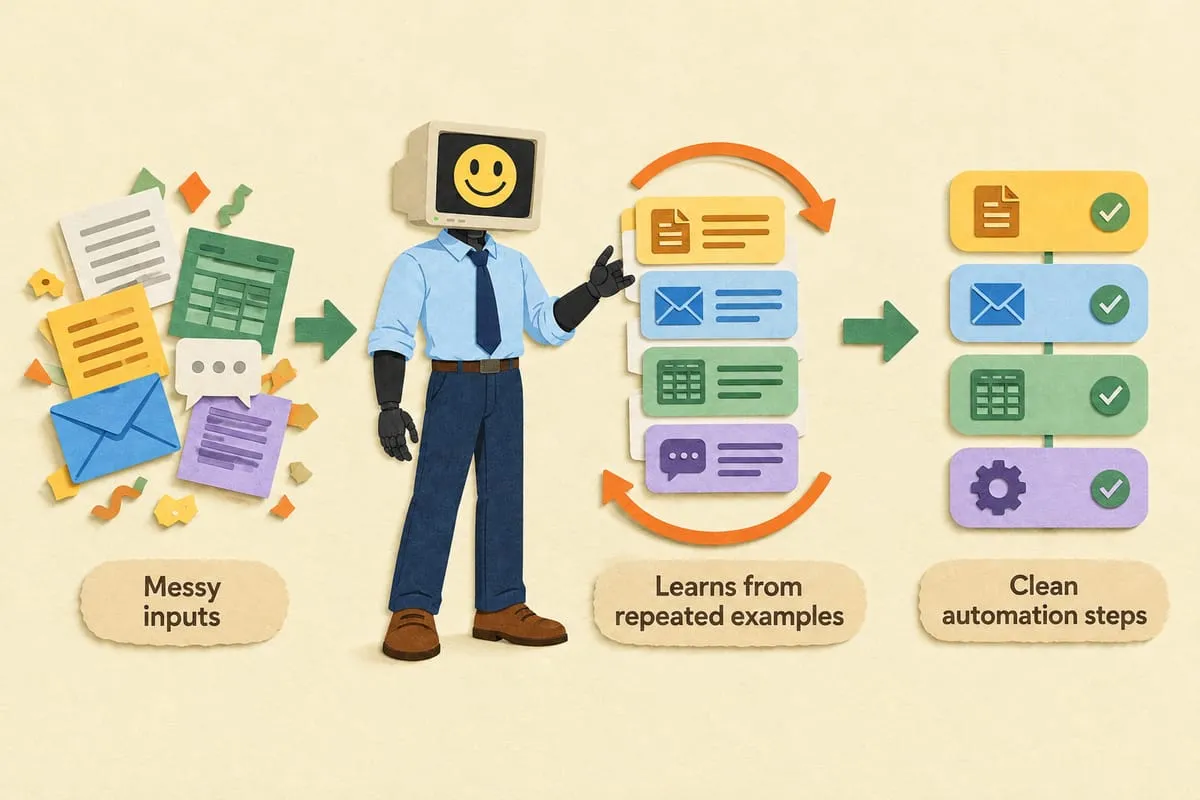
AI learns patterns. Instead of following rigid rules, an AI system is shown thousands of examples. “Here are 10,000 invoices. Here’s where the total is on each one. Figure out the pattern.” After enough examples, the AI can find the total on an invoice it’s never seen before, even with a completely different layout.
That’s machine learning. Nobody gave you a rulebook for identifying your mom’s face as a kid. You just saw her enough times that you figured it out. Same principle.
”Is ChatGPT the same as AI?”
Yes and no.
ChatGPT is one type of AI — a large language model trained on enormous amounts of text that learned to predict what words should come next. That’s why it can write emails, summarize documents, and hold conversations.
But it’s not the only type. The AI flagging your fraudulent credit card transaction is different. The AI reading your invoices is different. The AI recommending products on Amazon is different.
Thinking “AI = ChatGPT” is like thinking “vehicle = pickup truck.” A pickup truck is definitely a vehicle. But so is a sedan, a motorcycle, and a forklift.
For business purposes, what matters isn’t the specific technology. It’s this: can AI handle a task that currently eats up your team’s time?
Why this matters for your business
AI automation takes the repetitive, mind-numbing work your team hates doing and does it faster, more consistently, and without needing a lunch break.
Reading invoices and entering data. Answering the same 15 customer questions. Sorting incoming emails. Spotting weird transactions in a sea of normal ones.
Not because it’s smarter than your team, but because it doesn’t get bored, doesn’t get tired, and doesn’t accidentally skip a line on invoice number 347 at 4:45 on a Friday afternoon.
The businesses getting real value from AI aren’t buying the fanciest tools. They looked at their operations, found the boring bottlenecks, and asked, “Could a machine handle this?” Usually, it can.
If you’re curious whether that applies to your business, check out Does my business need AI? or our practical guide to business AI.
The one takeaway
AI is pattern-matching software that learns from examples instead of following rigid rules. That single idea is what makes it useful for business — it can handle messy, real-world tasks that traditional software chokes on. Invoices that all look different, customer emails that say the same thing fourteen different ways, financial data that never quite lines up.
This is Part 1 of our AI for Business Owners series.
Not sure if AI is right for your business? We can help you figure that out. No pressure, no pitch deck — just a conversation about what’s going on in your operations and whether AI makes sense.